You do not need to buy the capability. You need to build it
A lot of organisations are still treating AI capability as if it were something they can procure.
Buy the platform. Sign the enterprise deal. Enable the seats. Approve the use cases. Run the rollout.
Then call that capability.
That logic is already breaking.
The models matter. The infrastructure matters. The vendors matter.
But the real advantage is moving somewhere else.
You do not mainly need to buy the capability. You need to build it.
That is the shift many AI strategies are still refusing to admit.
The model is purchasable. The capability is not
This is the strategic shift.
The raw cognitive engine is increasingly available on demand. You can pay for model access. You can pay for inference. You can pay for wrappers, copilots, and platforms.
But none of that means the organisation has formed a capability.
Capability exists when the organisation can repeatedly do something useful, reliable, governed, explainable, and improvable.
That does not arrive in a vendor contract. That has to be built into the organisation itself.
The organisation still has to build the surrounding system
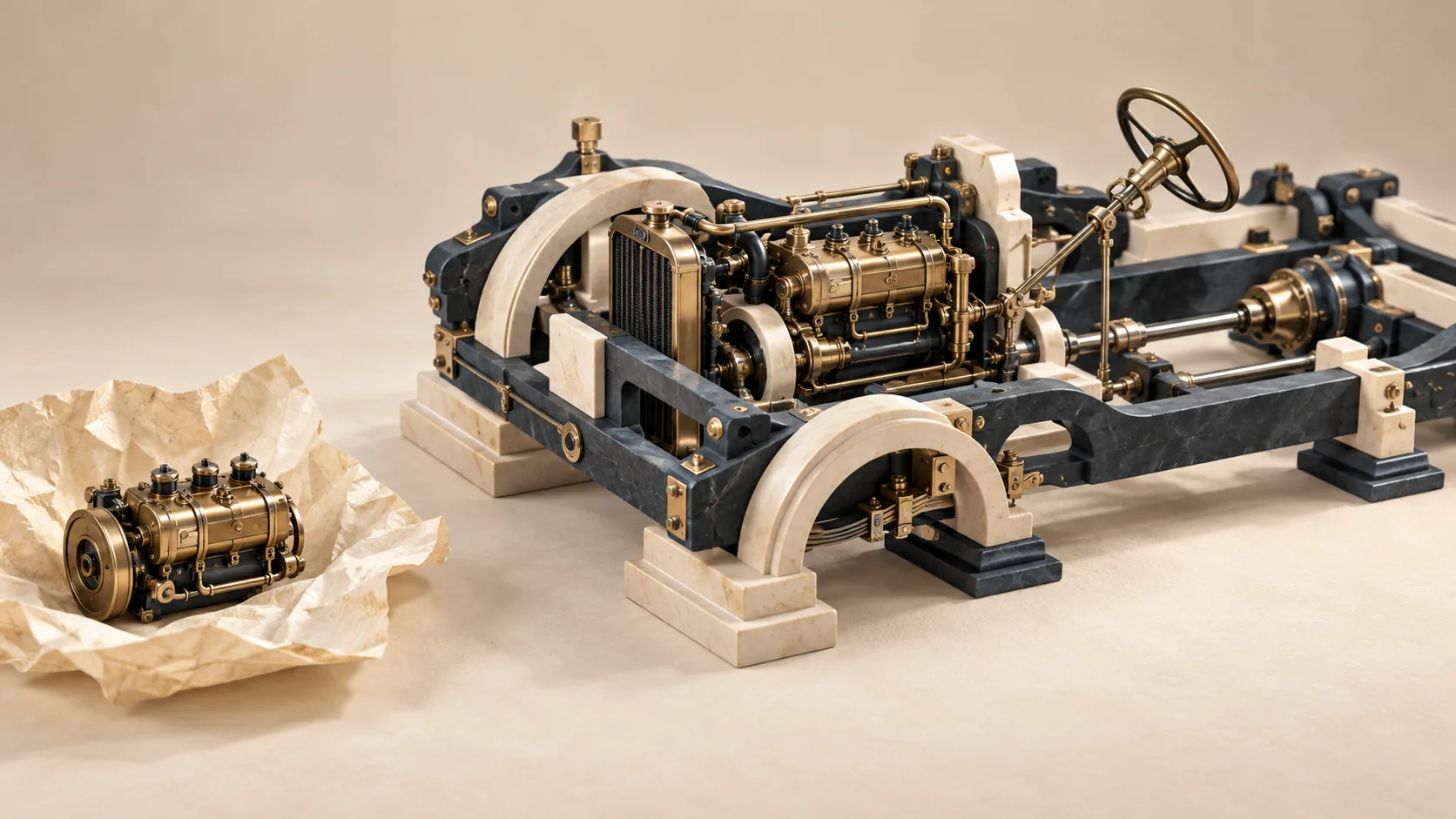
If the model is the engine, the organisation still has to build the vehicle.
It has to build:
- the context the model works from
- the workflows the model participates in
- the memory the model can learn through
- the standards that shape acceptable output
- the governance around action and risk
- the contribution loops that let learning compound
- the reuse patterns that stop every win from being local and temporary
That is where the capability actually lives.
Without that surrounding system, the organisation is not building capability. It is renting flashes of intelligence.
This is why buying more AI layers often disappoints
When results are weak, the enterprise reflex is usually the same.
Buy another layer. Buy governance. Buy orchestration. Buy search. Buy observability. Buy another wrapper.
Sometimes those tools are genuinely useful. But they do not solve the underlying problem on their own.
They do not automatically:
- make the organisation more coherent
- expose trapped knowledge
- redesign bad workflows
- reduce hidden dependencies
- create durable reuse
- connect decisions back to purpose
- turn scattered experiments into operating strength
Those are organisational build tasks. Not procurement outcomes.
The new asymmetry is the real opportunity
There has never really been a period like this.
An organisation can now access extraordinary amounts of reasoning, drafting, synthesis, pattern recognition, and problem-solving for a tiny fraction of what equivalent human-only effort would have cost.
That changes the boundary of what is realistic to build.
Capabilities that used to look too expensive, too slow, or too coordination-heavy can now become practical.
Not because AI makes the organisation irrelevant. Because it lowers the cost of building the organisation's own capabilities.
That should change the ambition.
The question is no longer only:
- which AI product should we buy
It is also:
- what capability can we now build that used to be out of reach
- what trapped knowledge can we now turn into working structure
- what under-maintained internal systems can we now finally tend properly
- what patterns can we now make repeatable instead of heroic
Those are bigger questions. And they matter more.
They force the organisation to think like a builder, not just a buyer.
The best organisations will treat models as inputs, not the finished answer
Over time, access to strong models will spread. They will become more embedded, more substitutable, and less unique.
That means the durable advantage is unlikely to come only from having a model. It will come from what the organisation builds around it.
The real differentiators will be things like:
- better internal context
- better memory
- better workflow design
- better governance at the point of action
- better contribution and reuse loops
- better agent coordination
- better ability to improve the system from inside the work
That is organisational capability. Not purchased intelligence.
Procurement is still necessary. It is just no longer enough
This is not an argument against buying tools. Procurement still matters.
It is an argument against mistaking procurement for capability formation.
AI strategy is no longer mainly a sourcing question. It is increasingly a build question.
How will the organisation use purchasable intelligence to create its own lasting strengths? How will it reduce dependence on hidden experts? How will it turn local wins into shared operating advantage? How will it build a system that gets better as it is used?
That is the real work now.
The right mental model
A better mental model is simple:
- you may pay for the models
- you may pay for the compute
- you may pay for some of the infrastructure
- but you build the capability
You build it in workflows. You build it in memory. You build it in standards. You build it in governance. You build it in contribution loops. You build it in reuse.
If that happens, the organisation becomes more than a customer of AI.
It becomes a builder of its own capability.
That is where the serious advantage is likely to come from.
Series guide
This is part 1 of the short sequence:
- You do not need to buy the capability. You need to build it
- What organisational gardens actually are
- Your organisation can now evolve from within
- You can now build capability from within